
The cbso Framework: How to Stabilize and Transform Operations
You cannot transform what is not stable.
Most turnaround frameworks fail because they are too abstract or too rigid. They tell you what to do without explaining how. They prescribe steps without acknowledging that every company enters at a different point of distress.
The cbso Framework is different. It is a diagnostic and execution tool built on four phases and three lenses. It meets companies where they are and moves them forward systematically.
How It Works
The framework operates across two dimensions:
Four Phases (horizontal):
Crisis Mitigation → Stabilization → Turnaround → Transformation
Progression from damage control to sustainable growth.
Three Lenses (vertical):
People → Process → Technology
The operational systems that must work together.
Rule: You do not implement the entire framework at once. You enter at the phase that matches your current state and work across all three lenses before advancing.
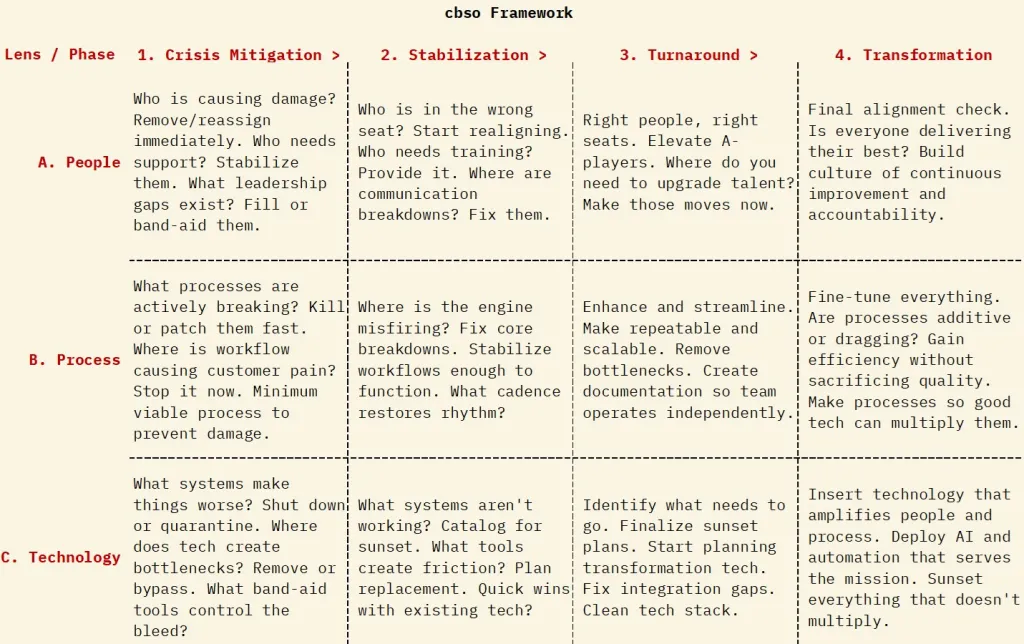
The Four Phases
Phase 1: Crisis Mitigation
Objective: Stop the bleeding. Stabilize leadership. Build credibility through quick wins.
This is damage control. You remove or reassign people actively causing harm. You kill or patch processes that are breaking the business. You shut down or bypass systems making things worse. The goal is simple: stop the damage so you can see what you’re actually dealing with.
You cannot build on fire.
When the bleeding stops, leadership is clear, and critical workflows function, you move forward.
→ Crisis Mitigation Operator’s Guide
The Reality Map
Before you can stabilize operations, you need to know what you’re stabilizing. The Reality Map is a two-week diagnostic exercise that closes the gap between perception and reality.
You ask every director what their team actually does. Who their partners are. What tools they use. Who their internal customers are. No goals, no narratives. Just the work.
What comes back will surprise you. Overlap consuming 20-40% of capacity. Ghost responsibilities no one owns. Mission-critical work buried in the wrong place. Zombie processes from five years ago.
The Reality Map becomes your operating system for stabilization. You cannot stabilize what you cannot see.
The Reality Map is included in the Stabilization phase guide.
Phase 2: Stabilization
Objective: Build discipline. Restore rhythm. Reset expectations and accountability.
You realign people to roles that match capability. You stabilize core workflows and establish operational cadence. You catalog broken systems and plan replacements. This is where rhythm returns. Teams execute without constant management. Processes become repeatable. Systems become reliable.
Discipline takes root.
When rhythm is restored and teams operate without heroics, you move forward.
→ Stabilization Operator’s Guide
Phase 3: Turnaround
Objective: Prove value. Build momentum. Create repeatable wins that compound.
You finalize seat alignment and elevate A-players. You streamline core processes and remove bottlenecks. You finalize sunset plans for legacy systems and fix integration gaps. This is where momentum becomes visible. High performers drive impact. Processes scale without breaking. Technology enables instead of constrains.
Wins compound. Credibility returns.
When momentum is proven and the team believes they can win, you move forward.
Phase 4: Transformation
Objective: Scale impact. Build durable infrastructure. Use technology to amplify strong teams.
You ensure peak performance and embed continuous improvement. You fine-tune processes for quality and efficiency. You deploy AI and automation that amplifies people, not replaces them. This is where sustainable advantage builds. Teams improve continuously. Processes compound. Technology multiplies capability.
Bad processes automated become bad processes at scale.
Transformation only works when built on stable operations. The sequence matters.
→ Transformation Operator’s Guide
Why This Framework Works
Most companies fail because they deploy AI before stabilizing process, transform before proving turnaround, and chase growth before building discipline.
The cbso Framework prevents that. It forces sequence. It demands foundation.
You cannot skip phases without consequence. Crisis mitigation without stabilization leaves you fighting the same fires next quarter. Stabilization without turnaround builds rhythm but no momentum. Turnaround without transformation proves value but cannot scale it.
The fundamentals never stopped working.
The cbso Framework ensures you execute them in the right order, at the right time, with the right focus.
Jump to Your Phase
Crisis Mitigation → Stop the bleeding. Stabilize leadership.
Stabilization → Build discipline. Restore rhythm.
Turnaround → Prove value. Build momentum.
Transformation → Scale impact. Amplify teams.
Chris Briggs works inside B2B services, SaaS, and PE portfolio companies to stabilize teams, fix fundamentals, and use AI to extend strong people and processes. One client per quarter. Interim and embedded.
Connect: cb@chris-briggs.com | LinkedIn | 30-Minute Intro Call
 cbStrategicOps | Transform How Your Business Runs