
cbso Framework Phase 1: Crisis Mitigation
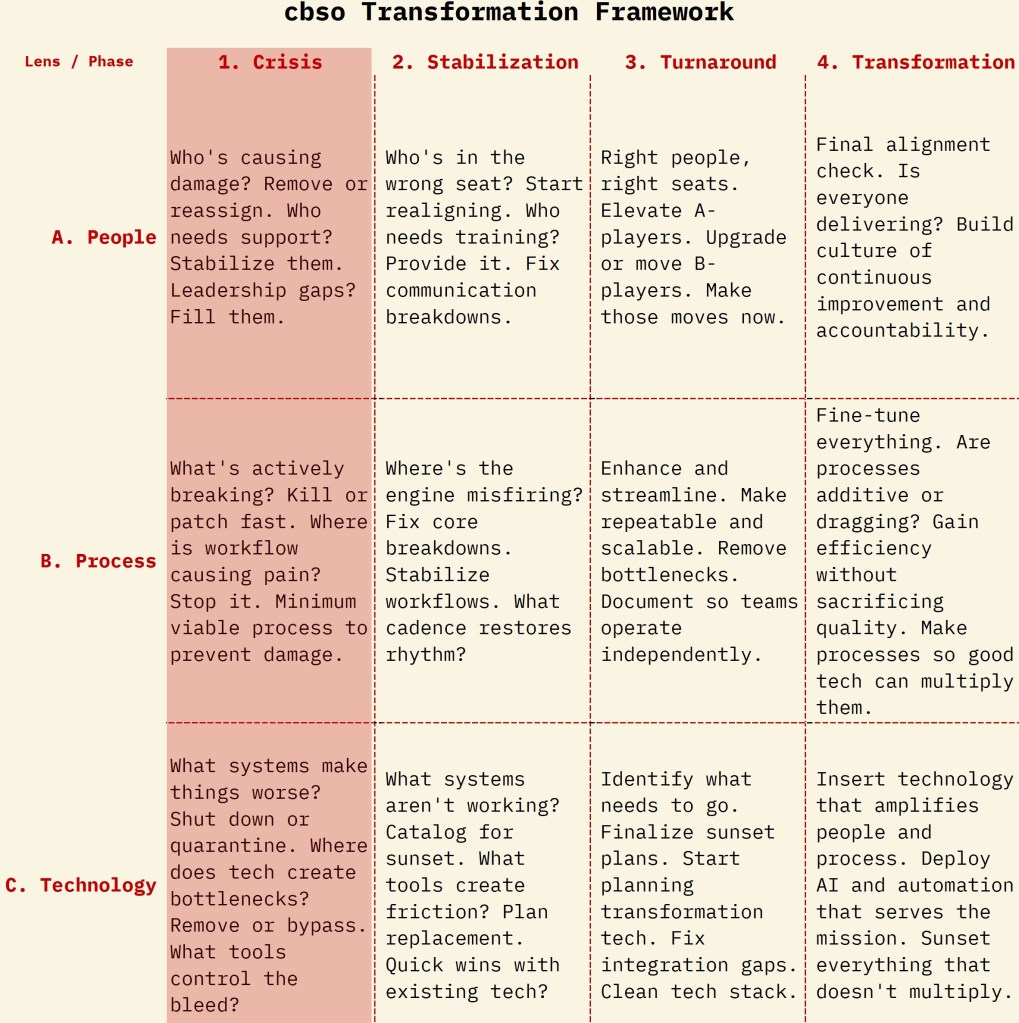
Objective: Stop the bleeding. Stabilize leadership. Build credibility through quick wins.
You’re in crisis when damage is active and accelerating. Revenue is leaking. Customers are leaving. Teams are in chaos. Leadership is unclear or absent. Critical workflows are breaking.
Crisis mitigation is damage control. You remove or reassign people actively causing harm. You kill or patch processes that are breaking the business. You shut down or bypass systems making things worse.
The goal is simple: stop the damage so you can see what you’re actually dealing with.
You cannot build on fire.
People – Crisis Mitigation
The Question: Who is causing damage? Who needs support immediately? What leadership gaps exist?
Actions:
- Remove or reassign individuals actively causing harm (incompetence, politics, misalignment)
- Provide immediate support to leaders who need it (direction, resources, air cover)
- Fill critical leadership gaps with interim or band-aid solutions
- Establish clear ownership and accountability
What Good Looks Like:
- Critical roles have clear owners
- Toxic players are neutralized
- No one asks “Who’s in charge?”
- Meetings produce decisions
Process – Crisis Mitigation
The Question: What processes are actively breaking? Where is workflow causing customer pain?
Actions:
- Kill or patch processes that are killing the business (fulfillment, invoicing, support)
- Stop workflows causing customer pain (even if manual)
- Establish minimum viable process to prevent further damage
- Create visibility into recurring failures
What Good Looks Like:
- Orders ship. Invoices go out. Support responds.
- No repeat escalations.
- Revenue leaks are plugged.
- Customers stop calling to scream.
Technology – Crisis Mitigation
The Question: What systems make things worse? What tech creates bottlenecks? What band-aid tools stop the bleeding?
Actions:
- Shut down or quarantine systems making things worse
- Bypass technology bottlenecks
- Deploy band-aid tools for control (spreadsheets, simple tracking)
- Halt all non-bleeding-related tech projects
What Good Looks Like:
- Broken systems are offline or bypassed
- Workflows move
- Teams have control (even if it’s Excel)
- IT stops getting 3 AM pages
When to Advance
The bleeding stops. Leadership is clear. Critical workflows function. Technology is either helping or out of the way.
When you can answer yes to these questions, you’re ready for Stabilization:
- Are critical roles clearly owned?
- Do orders ship, invoices go out, and support respond?
- Are workflows moving (even if manual)?
- Have you stopped the active damage?
If yes, advance. If no, keep mitigating.
But do not stay in crisis mode longer than necessary. Once the bleeding stops, start working to stabilize.
 cbStrategicOps | Transform How Your Business Runs